
Introduction
After that wedding project I mentioned in the pillar guide, I became obsessed with understanding why some AI tools handle couples better than others. Google Gemini stood out – it consistently preserved faces better, followed lighting instructions more literally, and handled cultural clothing more accurately.
But it wasn’t automatic. I had to learn how Gemini thinks differently. This guide shares what I discovered through months of testing.
For a complete foundation in couples photo prompts, including universal principles that work across all tools, check out our comprehensive Couples Photo Prompts – A Complete AI Portrait Guide .
Why Couple Portraits Are Difficult for AI
Couple portraits introduce multiple technical challenges that single-person portraits do not:
- Two faces must remain consistent in the same frame
- Body proportions must look natural together
- Lighting must match both subjects equally
- Cultural clothing must stay modest and accurate
- Facial expressions must remain subtle to avoid distortion
When prompts are written casually or creatively, AI often blends faces, exaggerates expressions, or breaks outfit realism. This is why structured prompts matter more than long or decorative descriptions.
Why Google Gemini Works Well for Couple AI Portraits
Through testing, I found that Google Gemini performs particularly well for couple portraits because it tends to follow literal prompt instructions more closely, especially for:
- Facial structure preservation
- Modest clothing interpretation
- Balanced lighting
- Controlled expressions
When I compared the same prompt across Gemini and other tools, Gemini consistently kept both faces recognizable while others sometimes swapped features. The difference was dramatic.
Many creators use ChatGPT to design and refine prompt text, then rely on Gemini to generate the final visuals. This separation of prompt design and image generation improves overall consistency.
Cultural Accuracy and Modesty in Couple Prompts
For culturally appropriate couple portraits, especially in South Asian contexts, prompts must clearly define modest fashion elements.
Key considerations:
- Dupatta placement (head and chest coverage where required)
- Avoiding revealing cuts or exaggerated poses
- Natural body distance between the couple
- Calm facial expressions instead of exaggerated smiles
AI models don’t “understand” culture unless you guide them. Clear instructions reduce unwanted Western styling or unrealistic fashion outcomes.
Early versions of my prompts kept adding Western styling to South Asian outfits. Once I started specifying “modest,” “dupatta covering head,” and “traditional cut,” Gemini understood exactly what I wanted.
Face Consistency Rules for Couples
Face inconsistency is the most common failure point in couple portraits.
Best Practices:
✅ Use at least one clean reference image for one subject
✅ If two references are supported, keep lighting similar
✅ Avoid wide smiles, laughing, or open-mouth expressions
✅ Use phrases like “maintain reference face accuracy”
✅ Avoid mixing multiple emotional cues in one prompt
When expressions are calm and neutral, AI can preserve identity far more reliably.
Prompt Structure Matters More Than Keywords
Many creators overload prompts with cinematic keywords hoping for better results. This often backfires.
Effective couple prompts clearly separate:
- Identity control – reference face rules
- Outfit description – simple, modest, specific
- Pose instruction – natural and realistic
- Environment – one clear setting
- Lighting – single light logic
This structure limits AI guesswork.
Educational Couple AI Prompt Examples
👗 Traditional Shalwar Kameez Style
Example 1 (Punjabi Style)
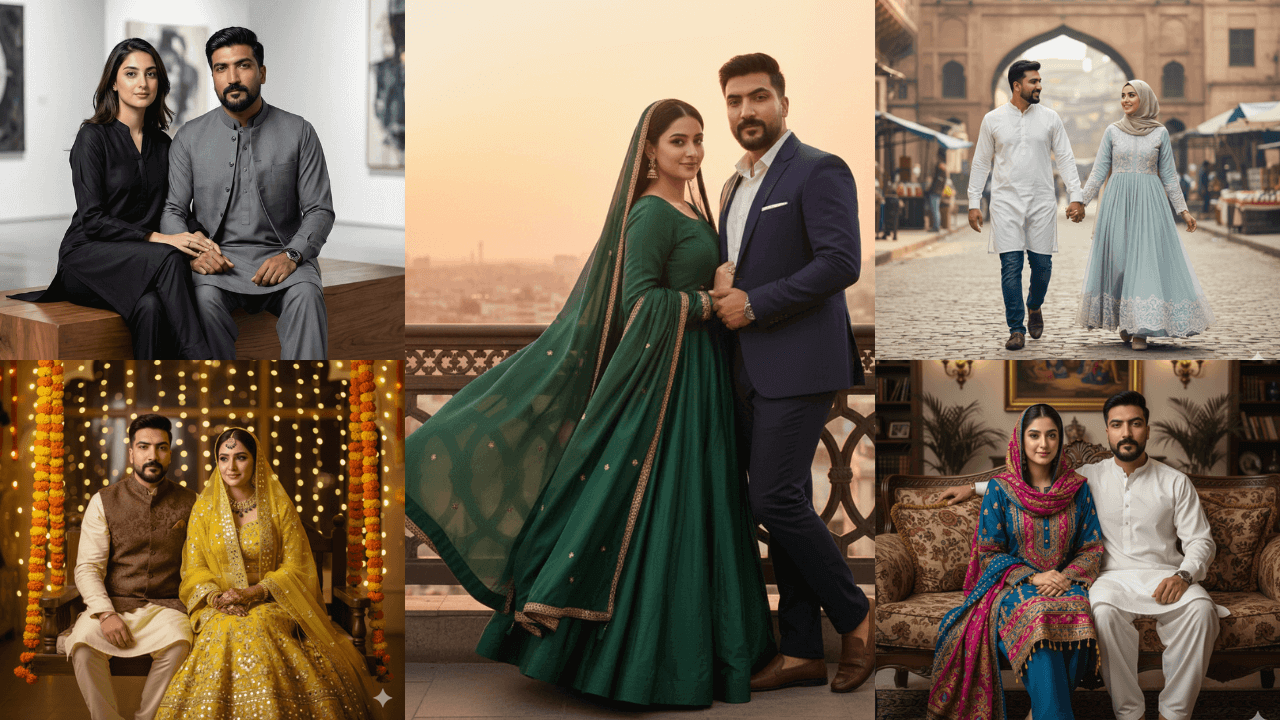
A stunning full-body portrait of a young couple (maintain reference face accuracy for both). Girl: Wearing an elegant, flowy Punjabi-style Patiala Shalwar Kameez with intricate embroidery and a soft silk dupatta draped modestly over her head. Boy: Wearing a modern fitted suit with a dark blazer and white shirt. Pose: They are standing closely in a serene outdoor garden, the girl is subtly leaning her head on the boy’s shoulder. Lighting: Soft, diffused daylight, rich fabric texture, 8K RAW Photorealistic, –ar 9:16.

This was the first prompt that finally worked for my friend’s wedding portraits. The key was “subtly leaning” – not too much pressure, just a gentle touch. The dupatta instruction ensured cultural accuracy.
Example 2 (Formal Shalwar Suit)
A captivating half-body portrait (same real face for the girl required). Girl: Dressed in a sophisticated, minimalist black shalwar suit with a structured kurta and sleek trousers. Boy: Wearing a modern grey Kurta-Pajama with a matching waistcoat. Pose: Sitting relaxed on a large wooden bench inside a minimalist art gallery, their hands gently touching. Lighting: High-contrast studio lighting, shallow depth of field, Ultra-Sharp Focus, Masterpiece Quality, –ar 9:16.

“Hands gently touching” was specific enough to show connection without looking forced. The minimalist gallery background kept focus on them. High-contrast studio lighting added drama without losing detail.
👠 Modern Frock / Churidaar Style
Example 3 (Churidaar Pajama)
A romantic close-up mid-shot (maintain reference face accuracy for both). Girl: Wearing an elegant, floor-length silk anarkali frock with Churidaar pajamas, and a beautifully styled dupatta. Boy: Wearing a tailored navy blue blazer over smart casual trousers. Pose: Standing on a balcony at sunset, the girl is looking tenderly at the boy, who is looking straight at the camera. Lighting: Warm ‘Golden Hour’ glow, atmospheric depth, Photorealistic Skin Texture, 4K resolution, –ar 9:16.

Mixed eye contact can be tricky – one looking at partner, one at camera. But it worked here because both expressions were calm. Golden hour glow unified the lighting beautifully.
Example 4 (Anarkali Frock)
A cinematic full-body shot. Girl: Wearing a flowing, modest Anarkali frock with delicate lace work, and a matching dupatta pinned neatly on her head. Boy: Wearing a casual, yet smart, white Kurta over denim jeans. Pose: Walking hand-in-hand down a historic, cobblestone street in Lahore, blurred background. Lighting: Bright, natural diffused daylight, motion blur effect on the ground, Intricate Fabric Detail, Magazine Cover Style, –ar 9:16.

“Walking hand-in-hand” created natural movement. The blurred background kept focus on them while the street added context. Motion blur on the ground added authenticity without making them blurry.
💍 Wedding & Festive Function Wear
Example 5 (Walima/Reception Look)
Highly stylized portrait (exact face retention required). Girl: Wearing a heavy embroidered Pakistani-style maxi dress (not revealing), with a heavy dupatta covering her head and chest. Boy: Wearing a sharp black tuxedo/suit. Pose: Standing on a grand marble staircase at a luxurious reception hall, looking poised and elegant. Lighting: Opulent interior chandelier light, deep shadows, 8K UHD RAW Photo, Masterpiece Quality, –ar 9:16.

Staircase shots add grandeur. “Not revealing” and “dupatta covering head and chest” were crucial for cultural accuracy. Chandelier light created that luxurious reception feel.
Example 6 (Mehndi Ceremony)
A vibrant half-body portrait. Girl: Dressed in a bright yellow and green Lehenga-Choli (modestly covered by a dupatta), hands decorated with mehndi. Boy: Wearing an embroidered Kurta-Pajama with a waistcoat. Pose: Sitting on a traditional swing surrounded by marigold flowers, both maintaining a calm, serene expression. Lighting: Warm, festive string lights glow, soft bokeh background, Ultra-Sharp Focus, Photorealistic, –ar 9:16.

Mehndi on hands was a detail that made the image feel authentic. The traditional swing and marigolds created perfect Mehndi ceremony atmosphere. “Calm, serene expression” prevented the AI from adding exaggerated smiles.
Example 7 (Casual Engagement)
A relaxed candid portrait (maintain face accuracy). Girl: Wearing a simple, elegant saree (modestly draped over her shoulders) with a full-sleeve blouse. Boy: Wearing a smart casual button-down shirt and chinos. Pose: Standing by a lakeside, the boy has his arm around the girl’s shoulder, both looking towards the horizon. Lighting: Clear, natural outdoor light, no digital painting, 4K resolution, –ar 9:16.

No digital painting” was a negative prompt that prevented the AI from adding artificial textures. Lakeside with both looking at horizon created a dreamy, romantic feel without forced interaction.
Example 8 (Pre-Wedding Shoot)
A dramatic cinematic full-body shot. Girl: Wearing a simple white frock with a light scarf draped over her hair. Boy: Wearing an open denim jacket over a T-shirt. Pose: Standing under a large tree in a field, holding hands and gazing at each other (poised look, no laughing). Lighting: Moody, overcast sky light, dramatic shadows, Masterpiece, Ultra-Sharp Portrait, –ar 9:16.

Overcast light is actually perfect for portraits – no harsh shadows. “Poised look, no laughing” ensured expressions stayed controlled. The tree added natural framing.
Example 9 (University/College Scene)
A candid street style shot. Girl: Wearing a modern, loose-fit shalwar kameez with sneakers and carrying a backpack. Boy: Wearing a hoodie and trousers. Pose: Walking quickly on a university campus path, looking forward, hands in pockets. Lighting: Bright urban daylight, slight motion blur, Photorealistic Skin Texture, no compression, –ar 9:16.

University scenes need authenticity. “Walking quickly” and “looking forward” created a candid, unstaged feel. Slight motion blur added movement without losing face detail.
Example 10 (Eid Festive Look)
A celebratory portrait. Girl: Wearing a brightly colored, embroidered lawn shalwar kameez. Boy: Wearing a white Kurta-Pajama. Pose: Sitting side-by-side on a decorative sofa in a traditional living room setting, looking confidently at the camera. Lighting: Warm interior lighting, rich color grading, 8K UHD RAW Photo, Intricate Fabric Detail, –ar 9:16.

University scenes need authenticity. “Walking quickly” and “looking forward” created a candid, unstaged feel. Slight motion blur added movement without losing face detail.
Common Mistakes to Avoid
Avoid these issues to maintain realism:
❌ Overusing cinematic or fantasy keywords – confuses the AI
❌ Mixing multiple lighting styles – one face lit differently
❌ Using low-quality reference images – blurry = bad results
❌ Adding emotional cues like laughing or shouting – distorts faces
❌ Expecting identical results across different tools – each AI is different
Better structure beats longer prompts.
Frequently Asked Questions
Can Gemini preserve both faces accurately in couple portraits?
Yes, when reference images are clean and expressions are controlled. My wedding project succeeded once I followed these rules.
Why should facial expressions stay subtle?
Extreme expressions distort facial geometry. AI has to “guess” what a smiling face looks like, and guesses often go wrong.
Can these prompts be adapted for other platforms?
Yes. The structure works across tools, though outputs may vary. For universal principles, our Couples Photo Prompts – A Complete AI Portrait Guide covers everything.
How many reference images do I need?
One per person ideally, with similar lighting and neutral expressions.
What if my tool doesn’t support two reference images?
Use one reference for the person who matters most, and describe the other clearly in text.
Final Thoughts
That wedding project taught me that Google Gemini, when used correctly, can produce couples portraits that look professionally photographed. The key is understanding how it thinks – literally, predictably, and best with clear structure.
After months of testing, I’ve learned that Gemini rewards clarity over creativity. Give it clean references, simple instructions, and let it do what it does best.
8 thoughts on “Gemini Couple AI Photo Prompts: An Educational Guide for Realistic Portraits (2025)”
Comments are closed.